Breast enlargement is a deeply personal choice and selecting the right implants is the most important decision you’ll make to reach your aesthetic goals.
When choosing the right size breast implants you’ll need to think about:
- Size - how large do you want the implant to be?
- Shape - would you prefer a natural-looking teardrop or a more pronounced round shape?
- Placement - whether over the muscle (sub-glandular) or under the muscle (sub-muscular) suits you better
- Profile - how far do you want the implant to project?
You’re not alone in this decision - our experienced breast augmentation surgeons are here to guide you to the best decision for your goals and lifestyle. Our goal here is to arm you with the knowledge to fully understand all the options breast enlargement involves, so you can make an informed decision.
Choosing the Right Size (Volume)
Implant size is measured in cubic centimeters (cc), not bra cup sizes. This is because a 300cc implant looks very different on a petite frame than it does on a wider torso.
What you need to think about when choosing cc sizes:
Torso size: Implants look larger on smaller, slimmer frames
Natural breast width: the base of the implant shouldn’t be larger or narrower than your natural breast width
Body proportions: breast augmentation is about balancing your entire silhouette
Lifestyle and physical activity impact: larger implants weigh more, which can affect high intensity exercise and workouts
Longevity: larger, heavier implants may cause the breast to sag (ptosis) faster and require an uplift or replacement sooner.
Breast enlargement surgeons take a tissue-based approach, where they measure your breast tissue and skin elasticity to see what your tissues can naturally support. This prevents a rippling effect and skin that looks overly thin.
Implant cc vs cup sizes
Bra cup sizes vary too much for an accurate measurement of volume increase, but its useful to get an understanding of how different implant cc volumes relate to cup sizes.
CC volume | Approximate cup size | What it looks like |
150cc | 1/2 to 1 full cup | Very subtle, natural enhancement. Best for a minor increase in volume. |
200cc | 1 full cup | Subtle enhancement, typically maintaining a natural appearance. |
250cc | 1 to 1.5 cups | A noticeable but modest increase in size. A common starting point for many patients. |
300cc | 1.5 to 2 cups | A popular choice providing a moderate and noticeable increase. |
350cc | 2 to 2.5 cups | Providing a fuller, more significant look. |
400cc | 2.5 to 3 cups | A larger volume for a more dramatic increase in size and fullness. |
450cc | 3 to 3.5 cups | Very significant volume increase. Patients should consider the impact on longevity and lifestyle at this size. |
500cc | 3.5 to 4 cups | A substantial and dramatic increase in size. Requires careful consideration of tissue support and long-term effects like ptosis (sagging). |
Choosing the Shape: Round vs. Teardrop Implants
The implant shape refers to how the silicone or saline is distributed within the implant shell.
Breast implants can vary from round to teardrop (anatomical) shape, with variations like 'rounded teardrop' in between. The shape will mainly determine the overall shapely appearance of the breast.
Feature | Round Implants | Teardrop (Anatomical) Implants |
Shape | Perfectly symmetrical spheres. | Sloped, with more volume at the bottom. |
Visual Result | Significant upper-pole fullness with significant cleavage and volume at the top of the breast | Subtle, natural slope down to the nipple with more volume in the lower pole, mimicking natural breasts |
Feel | Generally softer and more mobile. | Firmer "gummy bear" gel to hold shape. |
Rotation Risk | None; if they turn, the shape remains the same. | Low risk; however, rotation can distort breast shape. |
Lying Down | Spread naturally to the sides, like real tissue | Maintain a firmer, fixed shape |
| Best Suited For |
|
|
Choosing the Profile (Projection)
The profile, or projection, is how far the implant sticks out from your chest wall. Imagine two implants that both have 300cc of volume: one could be wide and flat (Low Profile), and the other could be narrow and tall (High Profile).
Low / Moderate Profile: Also known as mini or midi. Best for women with a wider chest wall who want a subtle, natural enhancement.
High / Ultra-High Profile: Best for women with narrow chests who want significant "pop" or projection. It allows for a larger volume without the implant being too wide for the chest.
Implant Placement: Sub-Muscular, Sub-Glandular & Dual Plane
The placement of the breast implant has a big effect on the overall aesthetic outcome, recovery time, and impact on physical activity.
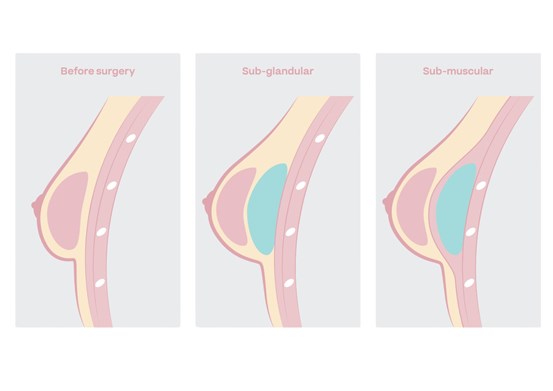
Submuscular Placement (Under the Muscle)
Here, the implant is placed under the chest muscle.
Aesthetic Appearance: Because the muscle covers the top of the implant, it creates a smoother, more gradual transition from the chest wall to the breast. This prevents the "bolus" look where the top edge of the implant is visible.
Best Suited For: Patients with thin natural breast tissue or those looking for the most natural "sloped" appearance.
Longevity & Safety: This placement is associated with a lower risk of capsular contracture (scar tissue hardening) and makes mammograms easier to perform and read.
Lifestyle Impact: The recovery is generally more intense and takes a bit longer because the muscle is being stretched. High-level athletes (like bodybuilders) may notice "animation deformity," where the implant moves slightly when the chest muscle is flexed.
Subglandular Placement (Over the Muscle)
The implant is placed directly behind the breast tissue and sits on top of the muscle.
Aesthetic Appearance: This can provide more immediate projection and "pop." However, if you have thin skin, the edges of the implant (rippling) may be more visible over time.
Best Suited For: Women who already have a significant amount of natural breast tissue to cover the implant, or those with slight sagging who want the implant to "fill" the skin envelope more directly.
Lifestyle Impact: Recovery is typically much faster and less painful because the muscle is left untouched. There is no risk of the implant moving when you flex your chest.
Longevity: Gravity acts more directly on the implant and the skin in this position, which may lead to sagging slightly sooner than submuscular placement.
Dual Plane (The "Hybrid" Standard)
The top of the implant is covered by the muscle (for a natural transition), but the bottom of the muscle is slightly detached so the lower part of the implant sits under the breast tissue.
Why it's popular: It offers the "best of both worlds." You get the natural upper-slope look and lower risk of scar tissue from the muscle coverage, but the implant can settle into the breast pocket more naturally for a better shape.
Use the Rice Test to help you decide
The "Rice Test" is a classic, low-tech way to "test drive" different volumes in the comfort of your own home. It helps you see how different sizes look under your favorite clothes - from a tight T-shirt to a professional blazer.
While it isn't an exact science (rice doesn't have the same "push" or projection as a medical-grade implant), it’s an excellent starting point for a breast enlargement consultation.
How to Perform the Rice Test
What You’ll Need:
A bag of uncooked rice (any type).
A pair of knee-high nylon stockings or thin "pop socks." (Avoid Ziploc bags, as the corners create an unrealistic shape).
A kitchen measuring cup (Standard 250ml/1 cup).
A non-padded bra or a sports bra that is currently a little loose on you.
Step-by-Step Instructions:
Measure the Rice: Use the conversion table below to measure the amount of rice for the CC (cubic centimeter) size you want to test.
Fill the Stocking: Pour the rice into the foot of the nylon.
Tie it Off: Tie a knot at the end, but leave some slack. You want the rice to be able to shift and mold to your chest wall, rather than being a hard, round ball.
Place and Wear: Tuck the "rice sizers" into your bra. Wear them for at least an hour while you walk, sit, and try on different outfits.
The "Rice to CC" Conversion Table
Since kitchen cups measure volume and implants are measured in CCs, use this guide to create your sizers:
| Desired Implant Size | Amount of Uncooked Rice |
| 200 cc | Approx. 3/4 cup |
| 250 cc | 1 cup |
| 300 cc | 1 + 1/4 cups |
| 350 cc | 1 + 1/2 cups |
| 400 cc | 1 + 2/3 cups |
| 450 cc | Just over 1 + 3/4 cups |
| 500 cc | 2 cups |
What to expect from a breast implant consultation
You'll meet face-to-face with an experienced breast surgeon for a consultation. There's no obligation or pressure here - this is just a discussion that involves your general health and medical history to make sure you're a suitable candidate for breast enlargement.
The surgeon will examine your chest area to advise on the different type and size implants that are best suited for your body, lifestyle and aesthetic goals.